What's my face shape?
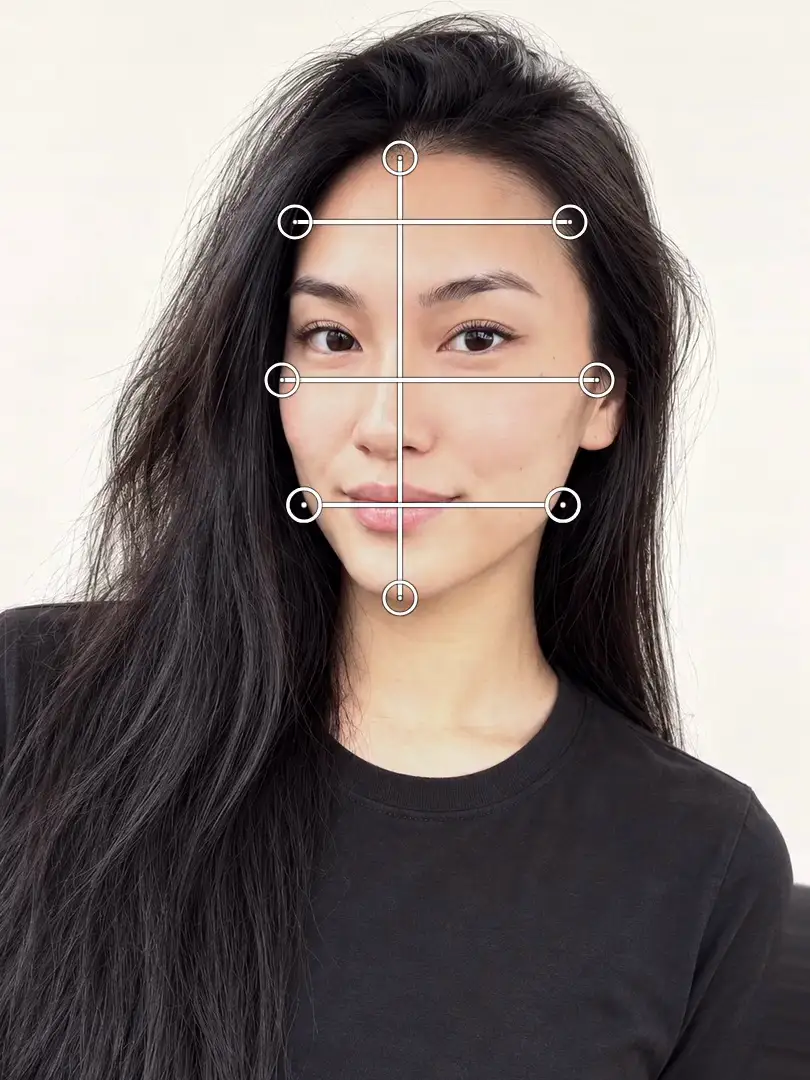
Mark four lines on one photo. See the cuts that suit it.
What are the face shapes?
Hairdressers usually sort faces into seven shapes by comparing four lines: the forehead, the cheekbones, the jaw, and the length from hairline to chin. Many faces sit between two shapes; the closest one is a starting point for choosing a cut.
 Oval
A little longer than wide, with a softly rounded jaw; most cuts work.
 Round
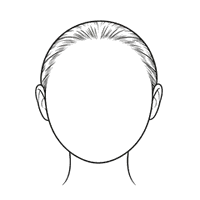
About as long as it is wide, with full cheeks and a soft jaw.
 Square
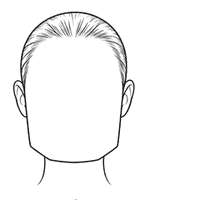
A strong, angular jaw, with forehead and jaw close in width.
 Heart
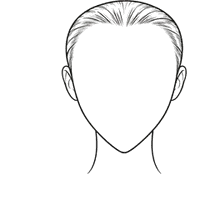
Wider at the forehead, narrowing to a small, pointed chin.
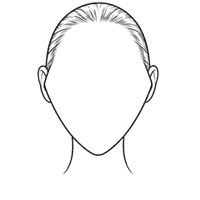 Diamond
Widest at the cheekbones, with a narrow forehead and chin.
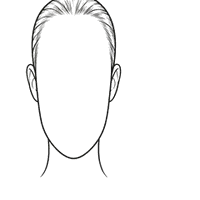 Long
Clearly longer than wide, with fairly straight sides.
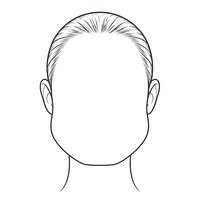 Triangle
The jaw is the widest line, the forehead the narrowest.
From your shape to a cut
Most face-shape advice works by adding what a face has less of. Round faces usually look balanced with height at the crown and length past the chin; square faces with soft layers and length past the jaw; long faces with width at the sides and bangs; heart faces with fullness from the ears down; diamond faces with a fringe and some width at the chin; triangle faces with volume at the crown and temples. An oval face rarely needs correcting. These are starting points: your hair's texture and the time you spend styling matter as much. Each shape page lists cuts from our catalog that usually work, and you can try any of them on your own photo before you book.
How the measurement works
You place seven dots on one front-facing photo, which make four lines. We compare the length with the widest line, and the forehead and jaw with the cheekbones, then ask one question the dots can't answer: are your jaw corners defined or soft? If two shapes come out close, the result shows both.
No photo? Pull your hair back, face a mirror and measure the same four lines with a soft tape: across the forehead, across the cheekbones, across the jaw at its corners, and from hairline to chin. Compare them the same way: the length with the widest line, and the forehead and jaw with the cheekbones. It works the same for men; with a beard, measure the jawbone, not the edge of the beard.
We do the math in this browser; the photo and the numbers never leave your device. The photo and your dots are kept in this tab only and cleared when you close it. The shape name and your hair answers stay on this device, so you can come back to your result.
It's a guide, not a diagnosis. Close-up selfies stretch the face, a smile widens the cheeks, and a tilted head shortens it, so take the photo from arm's length or further, at eye level, with your hair back.