Curtain bangs
Curtain bangs are a fringe parted down the center, or just off center, that is shortest at the part and longer toward the sides, so it opens like a pair of drawn curtains. Rather than covering the forehead straight across, the fringe frames the eyes and cheekbones and blends into the rest of the cut.

What are curtain bangs?
The length is yours to choose. A shorter version frames the brow line and sits closer to a real fringe; a longer one grazes the cheekbones or reaches toward the jaw and reads like the first layer of a layered cut. They can be cut full and heavy, like the 1970s originals, or light and wispy, with some forehead showing through.
They are not the same as face-framing layers. Face-framing layers start lower, around the cheekbones or below, and run down into the lengths; curtain bangs sit at the top of the face and are sometimes the only short piece in the whole cut. They go with almost any length, and stylists often pair them with layered cuts such as a butterfly cut, a shag or a wolf cut.
Much of the shape comes from how they dry. Left alone, hair settles the way gravity and its growth pattern send it, so the fringe drops straight down or splits hard at the part; guided out and away from the face while drying, it holds its curve.
Who it suits
Often suggested for
They suit most textures, though the styling changes: straight and wavy hair needs only a quick blow-dry, while coarse or tightly curled hair takes more work to keep the curtain shape. On fine hair, a length between the cheekbones and the jaw holds up better than very short or very long, and some stylists add round faces to the list as long as the sides stay long.
Curtain bangs vs bottleneck bangs
 Curtain bangs
 Bottleneck bangs
| Curtain bangs | Bottleneck bangs | |
|---|---|---|
| Shape | Parted down the center, curving out to both sides | Narrow at the top of the forehead, widening toward the temples |
| The center | Open, so some forehead shows at the part | Short and close together, like a soft fringe |
| Where the sides land | Anywhere from the brows to past the cheekbones | Around the eyes, curving out at the temples |
| Hair it suits | Most textures, with styling to match | Straight hair, or wavy hair that needs body |
If you want your forehead mostly open and an easy grow-out, choose curtain bangs. If you want something closer to a full fringe that still frames the eyes, ask for bottleneck bangs.
Curtain bangs variations
 Wispy bangs
A lighter fringe with thinned ends; cut wispy and parted down the center, it becomes a soft, airy take on curtain bangs.
 Face framing layers
The step down from bangs: pieces that start around the cheekbones and run into the lengths, with nothing on the forehead.
 Butterfly cut
Long layers with short pieces at the front, often cut with curtain bangs that lead into them.
 Long shag
Jagged layers all over; a shag is often worn with curtain bangs, a pairing that goes back to the 1970s.
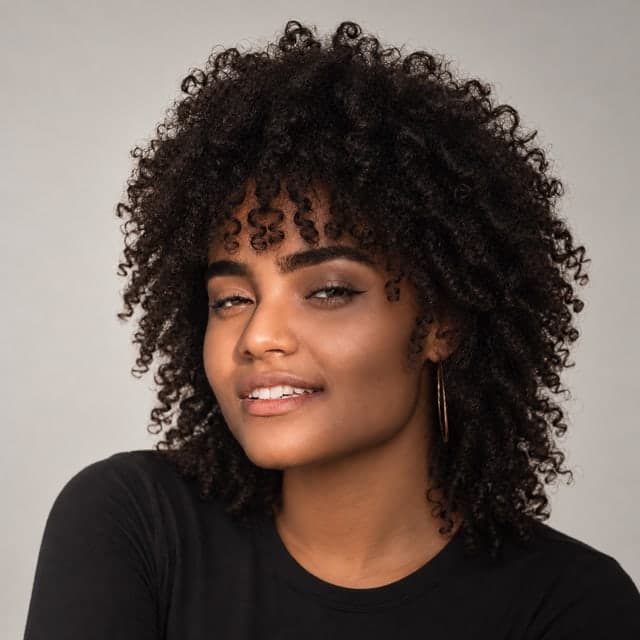 Curly shag
On curly hair the fringe is left longer and dried in its natural pattern, so the curls do the framing.
 Side bangs
Swept one way from a side part instead of opening to both sides.
Upkeep
Medium upkeep
Bangs reach the eyes long before the rest of the cut needs attention, so plan on fringe trims: salon guides suggest anywhere from every couple of weeks to once a month, depending on how long you wear them. Resting on your forehead, they pick up oil, sweat, makeup and sunscreen, so many people wash or dry-shampoo just the fringe between full washes. If you heat-style them every day, use a heat protectant. When you want them gone, they are among the easiest bangs to grow out: the long sides already blend into the layers, and a side part or a tuck behind the ear covers the in-between stage.
How to ask your stylist
- Bring photos and say where the shortest point should land: skimming the brows or sweeping the cheekbones. If you are unsure, start longer; a fringe can be shortened in the chair, but a too-short one has to grow.
- Say whether they should blend into face-framing layers or stand out as a fringe of their own, and whether you want them full or light and airy.
- Show where you part your hair. They sit on a center part or one slightly off center, and a cowlick at the front hairline changes how they fall, so point it out.
- On wavy or curly hair, keep them longer than you think. Cut too short, curls bunch up instead of opening out to the sides.
- On fine hair, ask for light layers so they move, and ask to be shown the blow-dry before you leave.
How to style it
Shape them while they are still damp. Put a round brush under the fringe, pull it forward first to take out any bends, then roll the brush out and away from your face with the airflow at the roots, and finish with cool air to set the direction. For more volume, roll a medium self-grip roller back from your face while you get ready, or wrap the bangs loosely around a medium-barrel curling iron and brush them out. Curly bangs can air-dry or be diffused on low; a light leave-in or a volumizing spray at the roots helps, while heavy waxes weigh them flat.
Questions
How can I see what I'd look like with curtain bangs?
Upload one clear, front-facing photo to Styloom and pick Curtain bangs. You get an AI preview of your own photo in about 20–30 seconds.
Are curtain bangs high maintenance?
They need a few minutes of styling most days and regular fringe trims. Because they blend into the rest of the cut, they ask less than short, blunt bangs; coarse or very curly hair takes the most work.
Do curtain bangs work on curly hair?
Yes, with a different approach, though sources disagree on how easy it is. Some warn that curls can lose the curtain shape; others say curly curtain bangs work well when they are cut longer and left to dry in their natural pattern.
Can you get curtain bangs with thin hair?
Yes. Ask for light layers, keep the length between the cheekbones and the jaw, and give them lift with a round brush or a little texturizing spray, since fine hair tends to lie flat.
Can I cut curtain bangs myself?
Stylists advise leaving it to a professional, at least for the first cut. A consultation takes your face shape, your features and how you wear your hair into account before anything is cut.
Sources
Written in our own words from common salon and barber advice. The example photos are AI-generated and show the style from the front. Updated November 6, 2026.