French crop
A French crop is a short men's haircut where the top is left a little longer than the sides and worn forward into a fringe across the forehead. The sides and back are kept short, usually with a taper or a fade. The fringe is the defining feature: cut straight and blunt for a clean line, or textured for a softer, piecey edge.
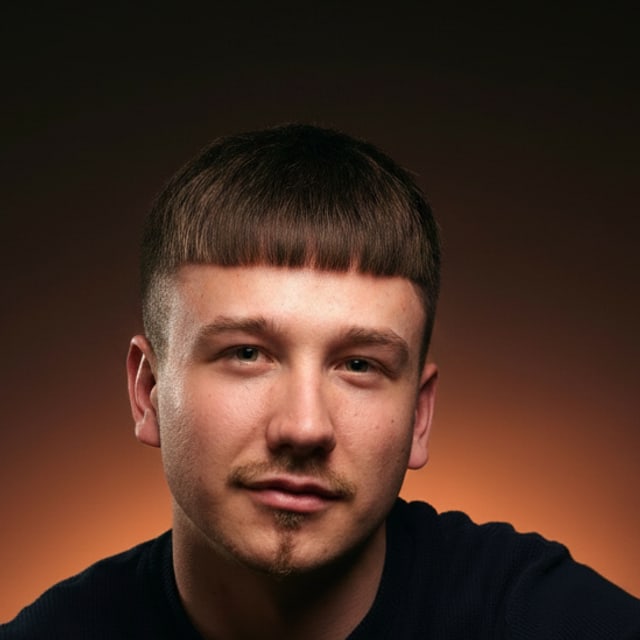
What is a French crop?
Most of the shape sits on top and at the front. The top keeps enough length to show some texture, and everything is directed forward instead of being swept back or to the side, so the fringe lands somewhere on the forehead: high, mid-forehead or just above the brows. The short back and sides keep the outline clean.
It belongs to a family of forward-fringe crops. A Caesar is shorter and more even all over, with a short, straight fringe; a textured crop is choppier on top and broken up at the fringe. Barber guides draw the line differently: some treat the French crop as one kind of textured crop, others call the textured crop its modern descendant. In the chair, the difference is the fringe. A heavier, cleaner line is what makes it a French crop.
The sides change the look most. A taper or a low fade keeps it soft and office-friendly; a mid or high fade adds contrast with the top; a skin fade takes the sides down to bare skin for the sharpest version. A burst fade, curving around the ear and leaving more length at the back, is another modern option.
Who it suits
Often suggested for
The forward fringe covers the temples and shortens a high forehead, which is why barbers often suggest it for a receding hairline; it won't hide thinning at the crown. It works on straight, wavy and curly hair, and texture through the top can make fine hair look fuller.
French crop vs caesar cut
 French crop
 Caesar cut
| French crop | Caesar cut | |
|---|---|---|
| Length on top | Short, with room for some texture | Very short and even all over |
| The fringe | Longer and heavier, blunt or textured | Short and straight, close to the hairline |
| Texture | Anything from a clean edge to messy | Little or none |
| Overall look | The fringe line is the feature | Neat and uniform |
If you want the fringe to show and some movement on top, ask for a French crop. For the shortest, simplest version, ask for a Caesar; a barber can move between the two by changing the length on top.
French crop variations
 Textured crop
The same forward shape with a choppier top and a broken-up fringe instead of one clean line.
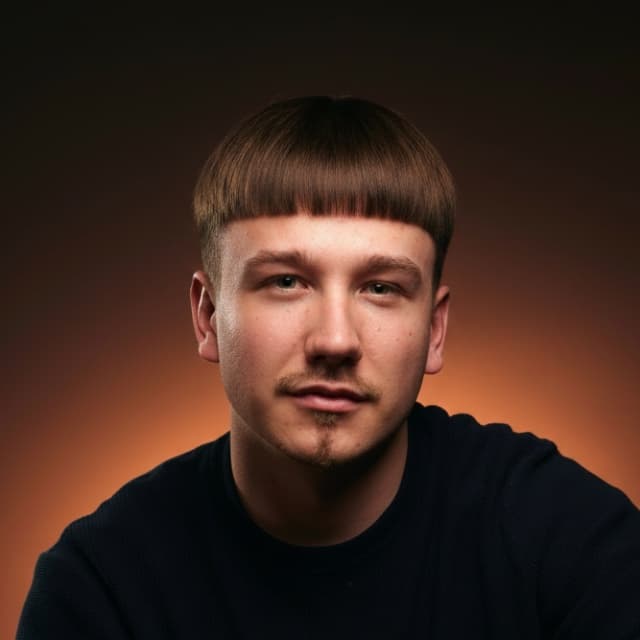 Edgar cut
A straight, bowl-like fringe cut in one sharp line, over tapered or faded sides.
 Low fade
The softest fade under a crop: it starts just above the ears, so the sides keep some weight.
 Skin fade
The sides taken down to bare skin, for the strongest contrast under the fringe.
 Curly top taper
The curly version: curls left a little longer on top so they can form, with the sides kept short.
Upkeep
Medium upkeep
The faded sides are the first thing to grow out, and a fade needs more frequent barber visits than a taper to stay sharp. The fringe comes next: once it starts to reach the brows, the clean line softens. The top itself is forgiving, and the crop grows out more gracefully than sharper cuts, so a few extra days between trims show on the sides long before they show on top. Hair that grows in a strong swirl at the front can resist a forward fringe and may need more product.
How to ask your barber
- Say how long the top should be and where the fringe should land: high on the forehead, mid-forehead or just above the brows.
- Choose the fringe finish. A blunt, straight line gives the classic French crop; a choppy, point-cut edge moves it toward a textured crop.
- Pick the sides: a taper, or a low, mid, high, skin or burst fade, and say how much contrast you want between the sides and the top.
- Mention any cowlick at the front so they can cut the fringe to work with it, and bring a photo of the finish you like, neat or messy.
How to style it
Towel-dry, work a small amount of matte clay or paste through the top with your fingertips and push it forward; blow-drying forward first gives more lift. Wavy hair needs little more than clay worked through while damp, and curls do better with a curl cream and air-drying. Use less product than you think: heavy wax makes the fringe clump instead of separate.
Questions
How can I see what I'd look like with a French crop?
Upload one clear, front-facing photo to Styloom and pick French crop. You get an AI preview of your own photo in about 20–30 seconds. Use a photo with your forehead visible so the fringe has room.
Is a French crop the same as a textured crop?
They overlap. Both are short crops worn forward; a French crop usually has a heavier, cleaner fringe line, while a textured crop is chopped up on top and at the fringe. Barbers use the names loosely, so bring a photo.
Does a French crop hide a receding hairline?
It's one of the most common suggestions for it, because the fringe covers the temples and the forehead. It doesn't do much for thinning at the crown.
Does a French crop work on wavy or curly hair?
Yes. Waves and curls add texture on top on their own; ask for the top left a little longer so they have room to form, with the sides kept short.
Is a French crop low maintenance?
Day to day, yes: styling takes a little product and a few minutes. The cut still needs regular trims, and more of them if the sides are faded.
Sources
Written in our own words from common salon and barber advice. The example photos are AI-generated and show the style from the front. Updated November 6, 2026.