Shag haircut
A shag haircut is a layered cut with shorter, choppier layers at the crown and through the mid-lengths, longer pieces around the face, and thinned, wispy ends. The layers build volume on top and let the outline break up, so it looks undone on purpose. It dates from the 1970s and is often worn with curtain bangs.

What is a shag haircut?
The shape comes from the contrast between a full crown and light edges. Short layers on top lift the hair, and the ends are texturized, by point cutting, razor work or slide cutting, so they fall in separate pieces rather than one solid line. How much weight comes out is the whole craft: too much and the hair looks thin, too little and it is just a layered cut.
The cut took off around 1970, credited to a New York stylist, and was worn by men and women alike. It came back in the early 2020s along with the wolf cut, a newer variation that pushes the contrast between a short crown and long ends further.
Today it covers a range. A soft shag keeps the layers blended through the mid-lengths; a choppy one is more obviously layered and piecey. Length runs from a short shag at the chin or collarbone to a long shag that keeps most of the length, with curtain bangs, a fuller fringe or none.
Who it suits
Often suggested for
Best with medium or thick density.
Wavy and curly hair shows a shag best, because the layers let the natural pattern spring. Thick hair loses weight it doesn't need, and straight hair works with a little product to bring out the texture. Fine hair can look fuller with layers, but it needs a light hand with the thinning.
Shag haircut vs wolf cut
 Shag haircut
 Wolf cut
| Shag haircut | Wolf cut | |
|---|---|---|
| Where the layers sit | Through the crown and mid-lengths | Packed into a short crown, then a big step down |
| The outline | Rounded and full around the head | Longer and thinner at the back, closer to a mullet |
| The finish | Undone but soft | Rougher and more angular |
| When it took off | Around 1970, revived in the 2020s | The 2020s |
Choose a shag for all-over texture and a rounder shape that grows out gracefully. Choose a wolf cut if you want more drama between a short, full top and long, wispy ends.
Shag haircut variations
 Long shag
The same layering on longer hair: movement through the lengths while most of the length stays.
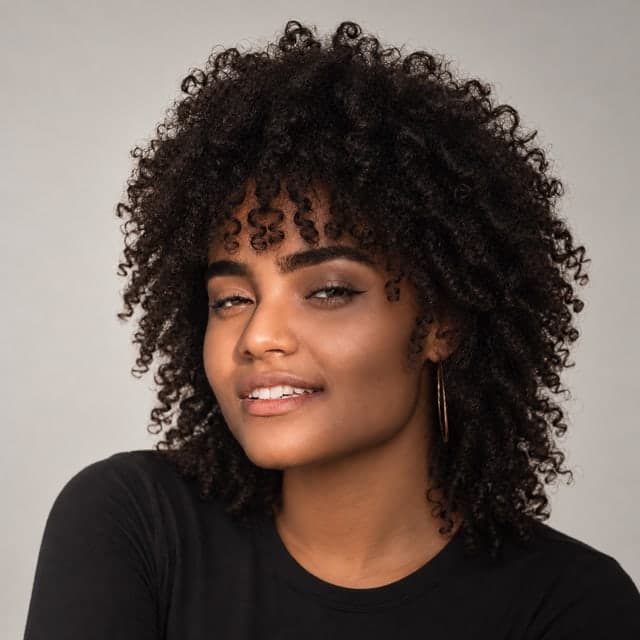 Curly shag
A shag shaped around curls, with a round, full crown and lighter ends.
 Curtain bangs
The fringe of a curtain bang shag: it splits in the center and sweeps out into the face pieces.
 Butterfly cut
Borrows the shag's short face layers but keeps the rest long and smooth, and is blown out for bounce.
 Shoulder-length feathered layers
A smoother shoulder-length cut: layers feathered back, without the choppy crown.
Upkeep
Medium upkeep
Day to day a shag asks for little, especially on hair with natural wave: a texturizing product and air-drying are often enough. The shape is what needs looking after. The crown layers drop and lose their lift first, and salon guidance puts a trim at about every eight to twelve weeks. Because the layers grow out gracefully, a slightly overdue shag still looks like a shag.
How to ask your stylist
- Bring two or three photos of the shag you mean, ideally on hair with your texture. The word covers everything from a soft, blended cut to a choppy 1970s one, and pictures say more than the name.
- Say soft or choppy: a soft shag has blended layers and is easy to grow out; a choppy one has more contrast and looks more piecey.
- Say where the shortest crown layer should sit, how long the ends should stay, and whether you want curtain bangs, a fuller fringe or none.
- Ask how they will texturize the ends (point cutting, a razor or slide cutting), and tell them if your hair is fine, so they take out less weight.
- If you have curls, ask for the layers to follow your curl pattern and whether they shape it dry, so each layer sits where it will actually live.
How to style it
Wavy and curly shags need the least work: scrunch a texturizing spray or curl cream into damp hair, then air-dry or use a diffuser on low. Straight hair gets the look from texturizing spray and a few loose bends with a flat iron. For a more polished version, run a round brush through the face pieces and bangs only and leave the rest undone.
Questions
How can I see what I'd look like with a shag haircut?
Upload one clear, front-facing photo to Styloom and pick Shag haircut. You get an AI preview of your own photo with the cut in about 20–30 seconds.
What's the difference between a shag and layers?
Every shag is layered, but not every layered cut is a shag. A shag uses shorter, choppier layers through the crown and mid-lengths and textured ends; ordinary layers are longer and blended, there for movement more than shape.
Does a shag haircut work on fine hair?
It can, and the layers can make fine hair look fuller. Ask for a soft shag with lighter texturizing, because thinning the ends too much leaves them see-through.
Is a shag haircut low maintenance?
Day to day, mostly yes, especially on wavy or curly hair that air-dries into shape. The trade-off is regular trims to keep the crown layers lifting.
Does a shag suit a round face?
It can. Stylists usually suggest longer layers and side-swept bangs on a round face, since they draw the eye down rather than out.
Sources
Written in our own words from common salon and barber advice. The example photos are AI-generated and show the style from the front. Updated November 6, 2026.