Undercut
An undercut is a haircut with the sides and back clipped or shaved short and the top left long, with no blending between the two. The long hair falls over the short section, so there's a clear line instead of a gradual fade. The top is usually slicked back, swept to one side or pushed up into a quiff.
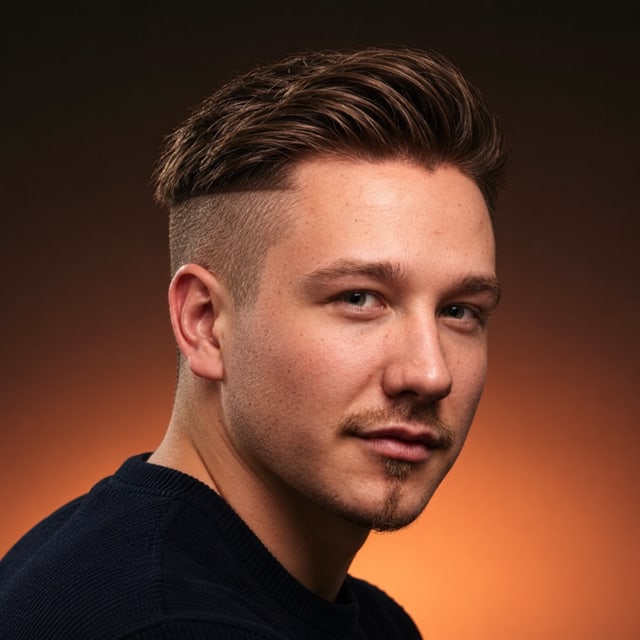
What is an undercut?
The short part is usually one even length, taken with a clipper guard or shaved to the skin, and it stops at a hard line that runs around the head above the ears. Everything above that line is cut much longer, so the top has the weight to be slicked, parted or pushed up, and the long hair falls over the short section underneath.
The style was common from the 1910s to the 1940s, when leaving the sides unblended was the cheap alternative to a properly blended short back and sides. It came back in the 2010s, mostly worn slicked back or swept to the side.
Barbers use a few names for the variations. A disconnected undercut keeps the hard line, which is the classic look. A blended undercut softens the step slightly, and an undercut with a fade grades the short part for a subtler effect.
The length of the top changes the routine more than the sides do. A short top is quick to style; a medium or long top gives you a slick back, a pompadour or a side sweep, and takes more time each morning.
Who it suits
Often suggested for
Less often suggested for long or diamond faces.
Height on top over tight sides makes the face look longer, which is why it's suggested for round and square faces; on a long face, a lower top keeps it in balance. It's easiest on thick, straight or wavy hair, where the short sides take out bulk and the top has the weight to hold its shape. Curly hair works too if the top is left longer.
Undercut vs high fade
 Undercut
 High fade
| Undercut | High fade | |
|---|---|---|
| Between sides and top | A hard line, no blending | Graded from short to longer |
| The sides | One short length, clipped or shaved | Shortest at the bottom, longer toward the top |
| Top length | Long enough to slick back, part or push up | Any length |
| Growing out | Regrowth shows fast and the line softens | Grows out more gradually |
For the strongest contrast and a long top to style, ask for an undercut. For short sides that grow out more evenly, with no line between the sides and the top, ask for a high fade.
Undercut variations
 Slick back
The classic undercut top: long hair brushed straight back with pomade.
 Modern pompadour
Volume swept up and back over the short sides.
 Textured quiff
A shorter top pushed up at the front; suits hair that's thicker than average.
 Side part taper
A combed side part; with a shaved line along the part it becomes a hard part undercut.
 Comb over
A medium top combed to one side, with more volume than a slick back.
 Faux hawk
The top pushed up into a ridge down the middle; the short sides make it a tamer take on a mohawk.
Upkeep
High upkeep
The short sides show regrowth quickly, and the line between the sides and the top softens with it; barber guides suggest trimming the sides every two to four weeks. The top needs styling most days, more so the longer it is. Growing an undercut out takes several months, until the sides catch up with the top, and a long top can be tied back on days you don't want to style it.
How to ask your barber
- Say "disconnected undercut" if you want the hard contrast, and show where the line should sit: at the temple, or lower, just above the ear.
- Say how short the sides go: shaved to the skin, or clipped with a guard number. The lower the number, the shorter.
- Give the top length and say how you'll style it. A slick back needs more length on top than a short quiff.
- Ask how they'll shape the back and neckline, and whether the top should be cut with texture or kept heavy for a smooth, slicked finish.
- If you might want to blend it later, say so: leaving the sides a little longer keeps that option open.
How to style it
The top does all the work. For a slick back or side part, comb a pomade with some shine through damp hair; for a messier, matte look, work clay or paste through dry hair. A blow-dry before product gives a quiff or pompadour its lift, and wavy hair often holds better with a little wax. Keep product off the short sides, where it builds up.
Questions
How can I see what I'd look like with an undercut?
Upload one clear, front-facing photo to Styloom and pick Undercut. You get an AI preview of your own photo in about 20–30 seconds. The preview shows the top and the overall contrast; where the line sits on the side is something to settle with your barber.
What's the difference between an undercut and a fade?
A fade shortens the sides gradually so they blend into the top. An undercut doesn't blend: the sides are one short length and the top falls over them with a visible line.
What is a disconnected undercut?
It's the classic undercut, named for the gap between the two lengths: the short sides stop at a hard line and the long top doesn't blend into them. A blended undercut softens that step slightly.
Does an undercut suit a long face?
It's less often suggested for long faces, because the tall top and tight sides make the face look longer. Keeping the top lower and the sides a little longer helps.
How do you grow out an undercut?
Let the sides grow and keep trimming the top lightly until the two lengths meet; it takes several months. The middle stage looks less awkward if the sides are tidied rather than left alone.
Sources
Written in our own words from common salon and barber advice. The example photos are AI-generated and show the style from the front. Updated November 6, 2026.