Mid fade
A mid fade is a fade that starts partway up the side of the head, somewhere between the middle of the sides and the temples, and gets shorter toward the ears and the nape. It sits between a low and a high fade: more contrast than a low fade, more hair left on the sides than a high one.

What is a mid fade?
Low, mid and high only describe where a fade starts, not how short it gets. Barbers place it by the ear, the one fixed landmark on the side of the head: a mid fade begins roughly halfway between the top of the ear and the temple, about an inch higher than a low fade. Below that point the hair gets shorter toward the edges; above it, the sides blend into the top.
How short it goes is a separate choice. The bottom can be bare skin, which makes it a mid skin fade, or a short guard that leaves a shadow of hair, and the line can run level around the head or drop behind the ear. Some barbers blend the top of the fade out completely, others leave a visible line where it stops, so say which one you want.
Because the short section reaches the height where people see you from the side, a mid fade takes weight off the sides: the top looks taller and the head narrower than with a low fade, without the stark sides of a high fade.
It works under most tops: a messy textured top, a textured crop worn forward, a quiff or pompadour, a comb over with a part, or curls left long.
Who it suits
Often suggested for
Less often suggested for diamond faces.
Barbers describe the mid fade as forgiving on most heads, which is why it's often the default when someone just asks for a fade. On thick hair it takes bulk off the sides; with curls or waves, the close sides set off a fuller top.
Mid fade vs low fade
 Mid fade
 Low fade
| Mid fade | Low fade | |
|---|---|---|
| From the front | The fade shows clearly above the ears | Subtle; the sides look fuller |
| The outline | Narrower sides, a taller-looking top | Cleaner edges, little change to the shape |
| Goes well with | A quiff, a pompadour, a textured crop or curls | A side part or a slick back |
| Growing out | Steps show above the ear within two to three weeks | Regrowth sits low near the hairline and shows later |
Choose a low fade for a quiet change you can stretch between visits. Choose a mid fade if you want the fade to be seen and the top to stand out, without the stark sides of a high fade.
Mid fade variations
 High fade
Starts higher, close to where the top of the head curves down; the strongest contrast.
 Skin fade
Take the bottom down to bare skin for a mid skin fade: the same height with more contrast.
 Drop fade
Let the line curve down behind the ear toward the nape for a mid drop fade.
 Textured crop
A short, choppy top worn forward; the fringe balances the height a mid fade adds.
 Textured quiff
A top pushed up at the front, a natural match for the structure of a mid fade.
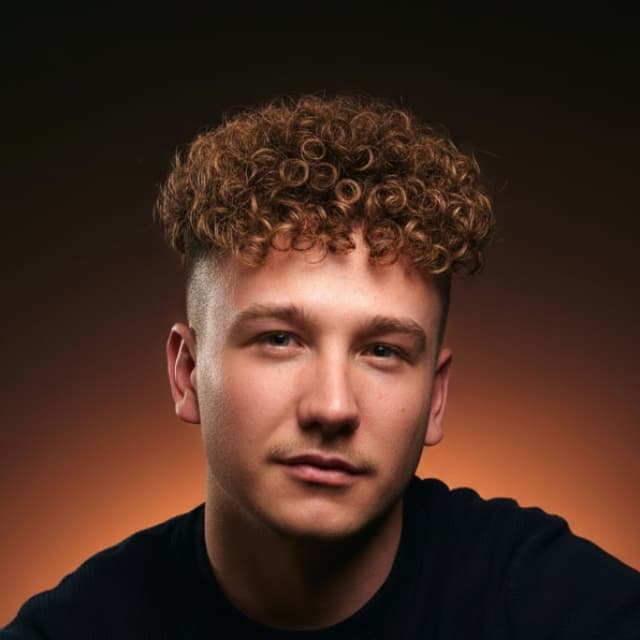 Curly top taper
Curls left long on top with the edges kept close.
Upkeep
High upkeep
Barber guides agree on a touch-up every two to three weeks. The short section is larger than on a low fade and sits higher, so regrowth shows sooner; the first sign is above the ear, where you start to see the steps between guard lengths. A low fade can usually go longer, somewhere between three and six weeks depending on who you ask. Day to day, the faded sides need nothing.
How to ask your barber
- Point to where it should start on your own head, about halfway between the top of your ear and your temple. "Mid" covers a range, so a finger is clearer than the word.
- Decide how far down the bottom goes: a short guard leaves a soft shadow of hair, while a skin finish shaves it clean. Name the finish rather than assuming a number means skin.
- Say whether you want the fade blended out with no line, or a visible line where it stops. Those are two different haircuts, and a barber won't guess.
- Describe the top you want on top of the fade (a crop, a quiff, curls) and how long it should stay, then pick the neckline: natural, rounded or squared.
- For a fade line that dips behind the ear toward the nape, the term to use is a mid drop fade.
How to style it
The faded sides need nothing; the top does the work. A messy textured top takes a little matte paste, clay or texturizing powder worked through dry hair; a quiff or pompadour needs a blow-dry for lift and a pomade to hold it; a slick back wants a shinier pomade or gel combed through damp hair. Curls do best with a curl cream and air-drying.
Questions
How can I see what I'd look like with a mid fade?
Upload one clear, front-facing photo to Styloom and pick Mid fade. You get an AI preview of your own photo in about 20–30 seconds. The preview shows the overall look from the front; the exact height of the fade is something to settle with your barber.
Is a mid fade the same as a taper?
No. A taper works only at the edges, the sideburns and the neckline, and usually stops short of skin. A mid fade takes the whole lower part of the sides and back down, starting partway up the head. A "mid taper fade" usually means a mid fade with a gradual change and no hard line.
What guard number is a mid fade?
There isn't one: "mid" is about where the fade starts, not its guard. A common ask is bare skin or a very short guard at the bottom, blended up to a #2 or #3 where the fade ends.
Does a mid fade work with curly hair?
Yes. Curls left long on top over a mid fade are a common pairing; the contrast between the close sides and the loose curl is the point.
Is a mid fade professional?
It's more noticeable than a low fade, which barber guides suggest for the most conservative look, and less stark than a high fade, which can read as edgy at work. Under a tidy top such as a side part or a comb over, a mid fade looks neat.
Sources
Written in our own words from common salon and barber advice. The example photos are AI-generated and show the style from the front. Updated November 6, 2026.